This time we'll cover the principles of space and size in relation to video games.
Space
Space is the empty, well, space in which your player interacts with the game world. Depending on how you have your game space set up, you will get very different feels for your game.
Naturally, small areas are claustrophobic, and large areas feel open and unconstricting. However, areas don't have to be small to feel small, and the inverse of this is true as well.
You can make a large room/area seem small by scattering obstacles and visual suggestions like walls, and shrubbery around.
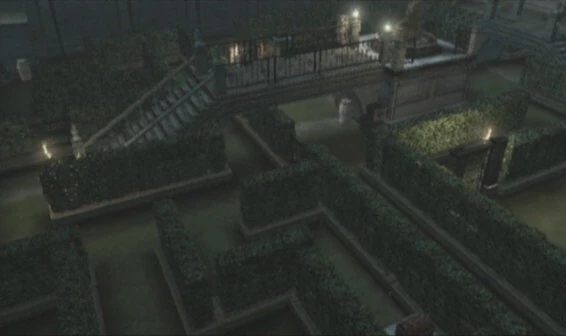
A great example of this type of setup is a maze or maze-like area in a game. Such a layout forces the player to break up a large room into much smaller pieces of a whole in their minds (Taylor, 2013).

Tight corridors with zombies and dogs everywhere. Fun (if you have a shotgun).
Inversely, you can make a small room seem larger by reducing obstacles and creating more 'open' visual elements.
The Binding Of Issac (the first one, not Rebirth) features labyrinths made up of many, uniformly sized rooms. Yet each and every rooms feels larger or smaller than the last. How is this done? Again, it's the same process as breaking a larger room into a smaller one. Scattering obstacles around but in a different fashion than before. Standard rooms have rocks and pits that block your path and some of the ways these blockages are set up make rooms feel very small.
 |
| The rocks form chokepoints that make it hard for the player to maneuver. Some rooms are completely made of obstacles. Screenshot by Marc Chea |
 |
| Boss rooms feel large because they are mostly clear to allow for maximum player movement. Screenshot by Marc Chea |
Different size spaces should elicit different kinds of responses (Taylor, 2013).
Take for example a horror game.
I consider for there to be two major types of horror games; the type where you can fight back, and the kind where the best you can do is run and hide.
For a more shooty game, large dark spaces where you can't see are pretty spooky. It can be more calming in a way to be in a narrow corridor where you can easily see everything going on around you and have no unpleasant surprises jumping at your face.
In games like the Dead Space series, I hate securing large open rooms with multiple entrances because then I have to cover multiple angles for monsters and that's how you get jumped from behind. The same idea lies behind the Five Nights At Freddy's series where you have to watch multiple areas creating a sense of vulnerable openness.
 |
| A vent AND a corner? It's gonna be a bad day. Screenshot by Marc Chea |
Conversely, if you can't fight back against monsters, large open areas are the best because then you can really run. Like in the segments where you play as Ashley in Resident Evil 4.
Size/Scale
Size is the physical volume which an object or element fills up. Scale is the relative size of one object compared to another (Bradley,2010). Yet these principles are more than just physical measurements.
Size implies power.
Size implies importance.
Size grabs a viewer's attention.
In relation to game aesthetics, size and scale can be used to make players feel a variety of different things. Feelings ranging from empowerment to helplessness to utter confusion.
Scaling a player up relative to their surroundings and other entities indirectly implies and increase in power. Scaling down a player will have the opposite effect of making them feel weaker and smaller. The amount scaled is (usually) proportional to the additional strength given to the affected player.
Objects in the game world can have their sizes scaled to achieve similar effects of power or weakness (Bradley, 2010). Additionally, scale can be used to confuse players by creating discrepancies in the relative sizes between objects. Imagine people having parts of their bodies randomly expanded or shrunk. Large heads, small hands, oversized feet. This kind of stuff implies confusion and oddity.
You're gonna have to kill that. Yes, you.
Next time we'll actually look at a game instead of just design principals.
-Marc
---
Sources
Bradley, S. (2010). How To Use Size, Scale, And Proportion In Web Design. Vanseo Design. Retrieved from http://www.vanseodesign.com/web-design/size-scale-proportion/
Taylor, D. (2013). Ten Principles of Good Level Design (Part 1). Gamasutra. Retrieved from http://www.gamasutra.com/blogs/DanTaylor/20130929/196791/Ten_Principles_of_Good_Level_Design_Part_1.php
Taylor, D. (2013). Ten Principles of Good Level Design (Part 2). Gamasutra. Retrieved from http://www.gamasutra.com/blogs/DanTaylor/20131006/197209/Ten_Principles_of_Good_Level_Design_Part_2.php
Image sources
[Image of Resident Evil 4's garden maze]. Retrieved March 18, 2015, from: http://vignette4.wikia.nocookie.net/residentevil/images/6/65/Castle_Garden.jpg/revision/latest?cb=20120113172159
[Image Ashley from Resident Evil 4]. Retrieved March 18, 2015, from: http://oyster.ignimgs.com/mediawiki/apis.ign.com/resident-evil-4/f/f3/Re4_04_03_04_05.jpg
[Image of player and a colossus]. Retrieved March 18, 2015, from: http://nerdreactor.com/wp-content/uploads/2014/07/Shadow-of-the-Colossus-SOTC-Wallpaper-Gaius-Earth-Knight-03.jpg



No comments:
Post a Comment